AIC313/CS378: Introduction to Generative Models
Minhyuk Sung, KAIST, Fall 2026
Time & Location
Time: Mon/Wed 10:30 a.m. - 11:45 a.m. (KST)
Location: E3-5 Room 210
Description
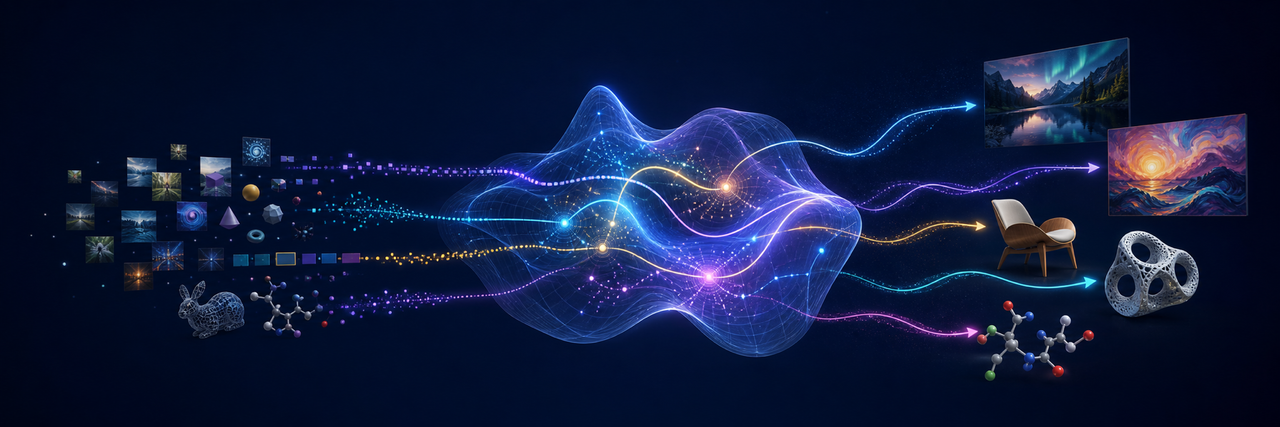
Generative models aim to learn complex data distributions and generate new samples, providing the foundation for a wide range of applications in computer vision, computer graphics, natural language processing, and scientific discovery. With the rapid development of deep learning, diverse generative modeling approaches have emerged, each offering distinct perspectives on learning and sampling from data distributions. In this course, we will cover the fundamental principles and recent advances in generative models, including autoregressive models, variational autoencoders, generative adversarial networks, normalizing flows, diffusion and score-based models, and flow matching. We will also discuss conditional generation, inference-time guidance, practical applications, and remaining challenges in the field.
Prerequisites
- Solid background in machine learning and deep learning
- Hands-on experience with neural network implementation
- Recommended prior courses:
- MAS.20050 Probability and Statistics
- MAS.20001 Differential Equations and Applications
- CS.30701 Introduction to Deep Learning
Course Staff
Instructor: Minhyuk Sung (mhsung@kaist.ac.kr)
Course Assistants:
- Mingue Park (kicikicik@kaist.ac.kr)
- Yunhong Min (dbsghd363@kaist.ac.kr)
- Prin Phunyaphibarn (prin10517@kaist.ac.kr)
- Yunjae Jeong (frogjj@kaist.ac.kr)
Textbook
The main reference for this course is:
Kevin P. Murphy, Probabilistic Machine Learning: Advanced Topics, MIT Press.
[Download Link]
We will mainly use selected material from Part I: Fundamentals and Part IV: Generation, supplemented with recent papers and lecture notes where appropriate.
Related Courses Offered in Previous Years
Grading
- Participation & Quizzes: 15%
- Exams: 45%
- FastGen Challenge: 20%
- CreativeGen Challenge: 20%
Important Dates
ALL ASSIGNMENTS ARE DUE 23:59 KST.
(Subject to Change)
- Project Team Sign-Up: Due Sep 28 (Mon)
- FastGen Challenge Mid-Term Evaluation (Optional): Due Oct 31 (Sat)
- FastGen Challenge Submission: Due Nov 07 (Sat)
- CreativeGen Challenge Submission: Due Dec 05 (Sat)
Schedule
(Subject to Change)
| Week | Date | Topic | Related Sections | Links |
|---|---|---|---|---|
| 1 | Aug 31 | Course Introduction | Ch. 20.1–20.4 | Slides |
| Sep 02 | Probability Background |
Ch. 2.1.2–2.1.3, 2.1.5–2.1.6; Ch. 2.2.1.2, 2.2.2.1; Ch. 2.3.1.1; Ch. 3.2.1.1 |
Slides Recording |
|
| 2 | Sep 07 | Autoregressive Models | Ch. 22.1–22.4 |
Slides Recording |
| Sep 09 | Variational Autoencoders 1 | Ch. 21.1–21.2.2 |
Slides Recording |
|
| 3 | Sep 14 | Variational Autoencoders 2 | Ch. 21.2.3–21.2.4 |
Slides Recording |
| Sep 16 | Normalizing Flows 1 | Ch. 23.1–23.2.2 |
Slides Recording |
|
| 4 | Sep 21 | FastGen / KCloud Session | ||
| Sep 23 | No Class (Break) | — | ||
| 5 | Sep 28 | Normalizing Flows 2 | Ch. 23.2.3-23.2.4 and 23.3 | |
| Sep 30 | Generative Adversarial Networks | Ch. 26.1–26.3.3 | ||
| 6 | Oct 05 | No Class (Substitute Holiday for National Foundation Day) | — | |
| Oct 07 | Energy-Based Models 1 | Ch. 24.1–24.2 | ||
| 7 | Oct 12 | Energy-Based Models 2 | Ch. 24.3–24.4 | |
| Oct 14 | Midterm Wrap-Up | |||
| 8 | Oct 19 | No Class (Midterm Week) | — | |
| Oct 21 | No Class (Midterm Week) | — | ||
| 9 | Oct 26 | Diffusion Models 1 | Ch. 25.1–25.2.2 | |
| Oct 28 | Diffusion Models 2 | Ch. 25.2.3–25.3.3 | ||
| 10 | Nov 02 | Diffusion Models 3 | Ch. 25.4–25.5.3 | |
| Nov 04 | Conditional Generation / Latent Diffusion | Ch. 25.5.4 and 25.6 | ||
| 11 | Nov 09 | Flow Matching 1 | Ch. 23.2.6 and 25.4 | |
| Nov 11 | Flow Matching 2 | |||
| 12 | Nov 16 | FastGen Recap / CreativeGen | ||
| Nov 18 |
Guest Lecture 1: Jiaxin Shi Meta SuperIntelligence Labs Discrete Diffusion |
|||
| 13 | Nov 23 | Inference-Time Scaling | ||
| Nov 25 | Recent Topics / Course Wrap-Up | |||
| 14 | Nov 30 |
Guest Lecture 2: Gyu Rie Lee KAIST Generative Protein Design |
||
| Dec 02 |
Guest Lecture 3: Julius Berner NVIDIA Fast Video Generation |
|||
| 15 | Dec 07 | Project Presentations 1 | ||
| Dec 09 | Project Presentations 2 | |||
| 16 | Dec 14 | No Class (Final Week) | — | |
| Dec 16 | No Class (Final Week) | — |
AI Coding Assistant Tool Policy
You are allowed (and even encouraged) to utilize AI coding assistant tools, such as ChatGPT, Copilot, Codex, and Code Intelligence, for your programming assignments and projects. Utilizing AI coding assistant tools will not be deemed as plagiarism. However, it is still strictly prohibited to directly copy code from the Internet or from someone else. Doing so will lead to a score of zero and a report to the university.
-
AI-generated using GPT
↩